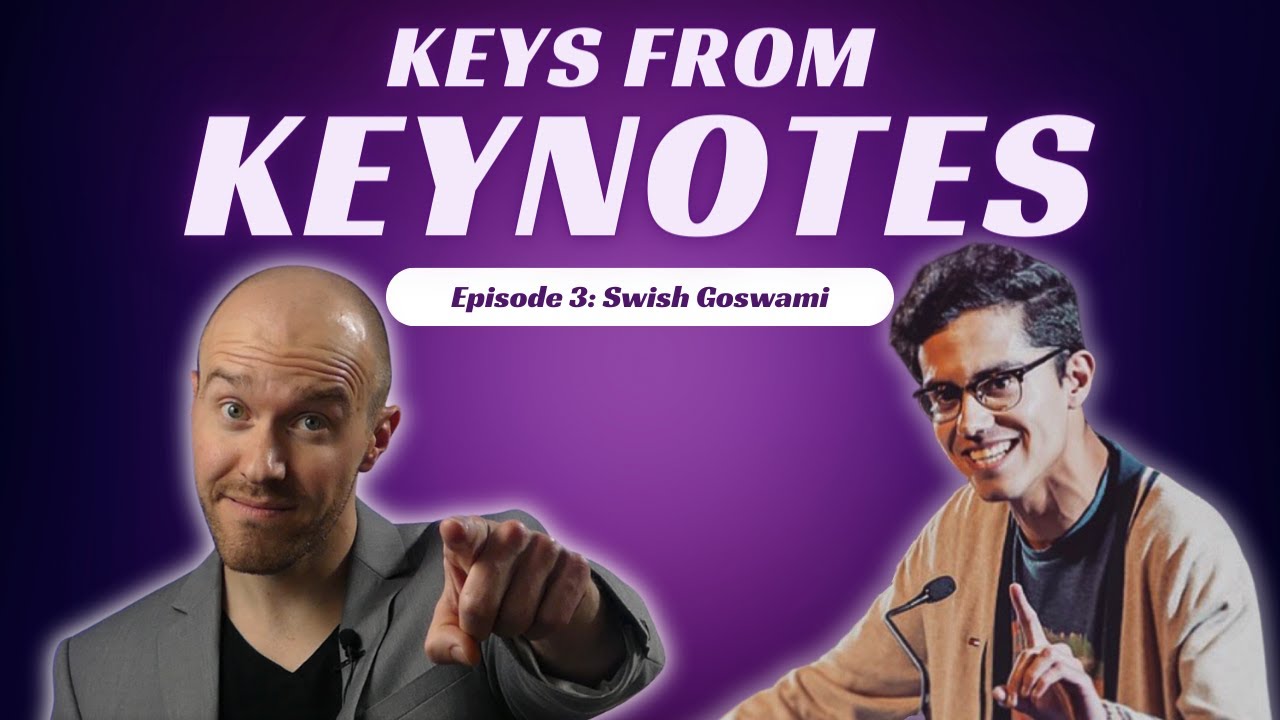
Public Speaking Is an Art You Have to Practice: Lessons from Entrepreneur Swish Goswami
Not every entrepreneur is a natural public speaker — and that's perfectly okay. Swish Goswami, a serial entrepreneur, podcast host, and sought-after keynote speaker, has been refining his craft since seventh grade. In a wide-ranging conversation on the Keys from Keynotes interview series, Swish shared how he went from debate club to international stages, why he ditches slides entirely, how he handles nerves and tough crowds, and what makes a truly memorable speech. His insights are a masterclass in authenticity, preparation, and the art of connecting with an audience.
The Myth That Entrepreneurs Are Automatic Public Speakers
There's a common assumption that if you can run a company, you can command a stage. Swish pushes back on that idea. While he acknowledges that many CEOs develop leadership qualities that overlap with public speaking — confidence, authority, the ability to pitch — he's adamant that speaking well is a distinct skill that requires deliberate practice.
"Public speaking, like anything, is an art," he says. "Anyone can go up and read off a piece of paper. But how many people will actually memorize their speech? How many will move around the stage, use hand motions properly, look into the eyes of the audience during the most dramatic part of their talk? How many will pause at just the right moment, or make jokes that feel spontaneous rather than scripted?"
For Swish, the journey started in seventh grade when he joined his school's debate team — partly inspired by his older brother, who had won the world debate competition while representing Canada. Swish went on to join Team Canada himself in tenth grade and made it to the world finals in twelfth grade. But more importantly, debate taught him something fundamental about his own style.
"I realized very quickly that I'm not the smartest in the room and I'm not the best-sounding person," he admits. "I have a hard time with S's and R's to this day. But I figured out I could bridge the gap — I could be a hybrid of substance and entertainment. When you heard me talk, you were going to laugh, you were going to smile, but you were also going to take away something important."
Authenticity as a Superpower
When Swish takes the stage, what you see is what you get. He describes his on-stage persona as identical to the way he'd talk to a friend over a beer — candid, loose, unfiltered. That authenticity, he believes, is what sets him apart from speakers who put on a polished performance but leave audiences feeling like they watched something artificial.
His approach rests on two pillars. First, he stays true to who he is. He uses slang, he's animated, and he doesn't try to project an image of perfection. Second, he focuses intensely on what he's saying rather than how he's saying it. Because public speaking isn't his full-time career — he's actively running a tech company called Surf — he has a constant stream of real-world lessons to draw from.
"Given the fact that public speaking is more of a side career, it's cool for me to still talk about lessons I'm learning as an entrepreneur, because I'm actively learning new ones almost every single week," he explains. "That keeps things fresh and grounded in real experience."
Why He Ditches the Slides
One of the most striking things about Swish's speaking style is his refusal to use visual aids. He'll stand on stage for thirty minutes with nothing but a handheld microphone and his words. It's a bold choice — and a deliberate one.
"I find visuals distracting," he says. "As an audience member growing up, whenever a keynote speaker came to our school, I'd lose attention and focus more on what was on the slide than what the speaker was actually saying."
Instead of relying on slides, Swish keeps audiences engaged through movement, eye contact, audience interaction, and sheer charisma. He makes a point of looking people in the eye, calling out audience members who laugh, asking questions, and getting people to raise their hands. These micro-interactions keep the energy alive and the attention focused squarely on him.
He also admits with a laugh that there's a practical side to his no-slides philosophy: "I'm also just lazy. Public speaking is not my full-time career, and there's so much happening across Surf, the podcast, and the volunteering I do." But even if he did create a slide deck, he says, it would contain no more than three or four slides — probably just a couple of videos he'd reference once and never return to.
Embracing the Nerves
Despite years of experience and dozens of talks, Swish still gets nervous before every single presentation. He doesn't eat or drink anything before a talk — if the speech is at 2 PM, lunch simply isn't happening. But he's reframed those nerves with the help of some wisdom from his mother.
"She told me that people who get nervous before public speaking might feel that way because they actually care about their talk," he shares. "You care so much about leaving the best impression and delivering the best message possible. For me, it's less about what people think of me and more about whether I can live up to the standard I've set for myself based on what I know I'm capable of."
That internal challenge — to meet or exceed his own previous best — is what drives the butterflies. And rather than trying to eliminate the nerves, he channels them into fuel.
The Power of Q&A and Fireside Chats
While many speakers dread the question-and-answer portion of an event, Swish considers it the most valuable part. He caps his keynotes at thirty minutes and actively encourages extended Q&A sessions or fireside chats afterward.
"The most valuable part of any talk is people asking questions rooted in their own experience," he says. "That's where the real connection happens."
When he doesn't know the answer to a question, he simply says so — no hedging, no pretending. "I'll give my best guess and tell the audience to take it with a grain of salt. Sometimes I'll even turn it around and ask the person what they think. Now I'm learning something too. That's the beauty of public speaking."
He traces this comfort with spontaneity back to his debate training: "In debate, you realize very quickly that the most important thing about public speaking isn't speaking — it's listening. If you don't listen to what someone is really trying to ask, you're not going to be an effective speaker."
How He Structures a Speech Without a Script
Swish doesn't write out full speeches. The one time he was forced to — for his first TEDx talk — he hated it. He finds that scripting every word creates a cage: "You're so confined to what's on paper. You start trying to remember every single word. People write 'pause' and 'wait for laughter' as stage notes, and it feels so cagey. You can't loosen up or be spontaneous."
Instead, his process looks like this:
- Write a strong opening: He scripts his intro — a joke, a couple of opening lines — because starting strong is critical to building momentum.
- Outline high-level themes: For his most-requested talk, "You Inc." (a blend of personal branding and entrepreneurship), he moves through buckets like building a business, having an entrepreneurial mindset in a corporate job, networking, personal branding, and mental health.
- Add bullet points under each theme: These are informed by conversations with event organizers about who's in the audience, their backgrounds, and what they're looking for.
- Leave room for spontaneity: He estimates that about 20% of what he writes down never gets said — replaced in the moment by something more interactive, personalized, or responsive to the energy in the room.
The Virtual Speaking Challenge
When the world shifted to virtual events, Swish had to adapt — and he's candid about the difficulty. His solution? He actually minimizes the Zoom window, moves it to the side, and puts up a background image of something comfortable (like a photo of Lewis Hamilton) so he can focus entirely on delivering his message without being distracted by participants' faces.
"Virtual talks are difficult because you really don't know if people are enjoying your talk," he explains. "They're on mute. You don't hear laughs or chuckles. The only way I can judge success is the quality and quantity of questions I get afterward. If people ask targeted questions — 'You said this, and I want to unpack it' — I know the talk landed."
Handling a Tough Room
Even the best speakers face rooms that aren't responding. Swish's approach is measured: don't force it.
"The worst thing you can do is force humor and force energy," he warns. "Getting people to yell 'woo' halfway through just to wake them up — that's not going to work."
Instead, he focuses on gradually working the audience up to his tempo. He starts calm and candid, gets a feel for the room, waits for a few laughs and interactions, and then slowly ramps up the energy. And when it doesn't work? He turns the lens inward rather than blaming the crowd.
"Even if you got a room that's half packed, you probably could have made them laugh. You could have left them more informed. I try to be critical of my own performances rather than just blame the audience."
Pre-Stage Rituals and Backstage Energy
Swish's pre-speech routine is refreshingly simple: he talks to people. Whether it's other speakers, event organizers, or the lighting and audio crew, he spends his final minutes backstage building camaraderie and keeping the energy positive.
"I always feel like we're part of a team — the people doing lights, audio, the organizers, the moderator. You want everyone from start to finish to be amped and ready to go."
Once on stage, he has a go-to icebreaker that instantly sets the tone: "How many people here, by a show of hands, had no idea who I was before that intro was read?" Most hands go up, and Swish laughs it off. The audience immediately knows they're dealing with someone who doesn't take himself too seriously — and the energy shifts.
His Most Embarrassing Speaking Moments
No conversation about public speaking would be complete without a few cringe-worthy stories, and Swish delivered two gems:
- The wrong panel: At the UN Youth Assembly, Swish accidentally walked into the wrong room and sat down on the wrong panel. He listened, confused, as the conversation shifted from entrepreneurship to GMOs and agriculture. It wasn't until he turned to the moderator and asked, "Am I in the right room?" that anyone realized the mix-up. He joined his actual panel fifteen minutes late.
- The near-fall: At a Signet Jewelers event, Swish was so passionately pacing the stage that he forgot about two carved-out holes on either side. His left foot found one of them mid-sentence. He caught himself at the last second, narrowly avoiding what he described as "a Travis Scott moment" — in front of an audience full of luxury jewelry brand executives.
Dream Venue and Favorite Speaker
When asked to name his favorite keynote speaker, Swish didn't hesitate: Sean Kanuck. He was particularly impressed by Sean's move during COVID to rent out an entire theater for his virtual talks — a bold, creative solution that Swish called "the most badass move I've ever seen a speaker do."
As for his dream speaking venue? The serious answer: the White House Rose Garden. The not-so-serious answer: St. Paul's Cathedral in London, his favorite building in Europe — though he acknowledged it might be a tough booking if you're neither a priest nor the Pope.
The Takeaway: Public Speaking Is a Craft, Not a Gift
Swish Goswami's journey from a seventh-grade debater to an international keynote speaker is a powerful reminder that great public speaking isn't something you're born with — it's something you build. It requires practice, self-awareness, a willingness to be vulnerable, and above all, authenticity. Whether you're presenting to a boardroom of five or a conference hall of five hundred, the principles remain the same: know your substance, connect with your audience, stay true to who you are, and never stop refining your craft. As Swish puts it, "Public speaking is an art — and it's an art you need to practice."