What Makes Simon Sinek's TED Talk One of the Greatest Ever? A Public Speaker's Breakdown
Simon Sinek's TED Talk, "How Great Leaders Inspire Action," is one of the most-watched presentations in TED history — and it's not because of fancy production values. In fact, the audio quality is so poor that Sinek has to switch microphones mid-speech. So what makes it so extraordinary? As a public speaker, I've studied this talk closely, and the answer lies in Sinek's masterful structure, vocal delivery, and ability to connect with an audience from the very first sentence. Here's a detailed breakdown of the elements that make this talk a masterclass in public speaking.
The Power of a Strong Opening
The first thing Sinek does brilliantly is his introduction. He doesn't waste a single second on pleasantries. There's no "Hey everyone, thanks for having me, my name is Simon." Instead, he opens with a thought-provoking question: "How do you explain when things don't go as we assume? Or better, how do you explain when people are able to achieve things that defy all assumptions?"
This is exactly what you want to do with the first words that come out of your mouth on stage. You have three options for a compelling opening:
- Ask a thought-provoking question that makes the audience lean in.
- Deliver a powerful statement that challenges conventional thinking.
- Jump straight into a story that captures attention immediately.
Too many speakers make the mistake of opening with a formal introduction — unnecessary biographical details that cause the audience to glaze over. Sinek skips all of that and dives right into the content. The result? He has the room's attention within seconds.
Relatable Examples That Build Curiosity
Shortly after his opening, Sinek introduces three relatable examples: Apple, Martin Luther King Jr., and the Wright Brothers. These aren't obscure references. They're universally recognised names and stories, which means the audience can immediately connect with what he's saying without needing extra context.
But here's the clever part — Sinek doesn't just list these examples. He uses them as a framework. He plants them early, signalling to the audience that these are the threads he'll weave throughout the talk. This creates a sense of anticipation. The audience knows something deeper is coming, and they want to stick around to see how these familiar stories connect to something new.
Vocal Variety and the Art of Pacing
One of the most striking elements of Sinek's delivery is his vocal variety. He doesn't speak at one speed or one volume throughout the entire talk. Instead, he adjusts his pacing deliberately based on the content:
- He speeds up when he wants to keep the audience thinking on their feet, creating a sense of momentum and urgency.
- He slows down when he wants a key point to truly resonate, giving the audience time to absorb a profound idea.
This dynamic delivery is a theme throughout the speech and one of the reasons it feels so engaging. The constant variation in rhythm keeps the audience locked in because they never quite know what's coming next. It feels like a conversation rather than a lecture.
Sinek also injects moments of humour from time to time. This isn't an overtly funny speech, but the light touches of wit — followed by a deliberate pause — allow the audience to react. That pause after humour is a powerful tool. It gives the room permission to laugh, and it gives the speaker a moment to reset before diving into the next point.
A Bold Statement That Changes Everything
After his opening question and relatable examples, Sinek delivers a statement that is arguably the turning point of the entire talk: "As it turns out, there's a pattern — and it's the complete opposite to everyone else. All I did was codify it."
This is a masterful move. Within the first couple of minutes, the audience has received a thought-provoking question, familiar examples they can easily grasp, and now a bold, contrarian statement that challenges everything they thought they knew. The result? They're hooked. They know they're about to learn something profound, and they're fully invested in hearing what comes next.
Simple Visuals, Maximum Impact
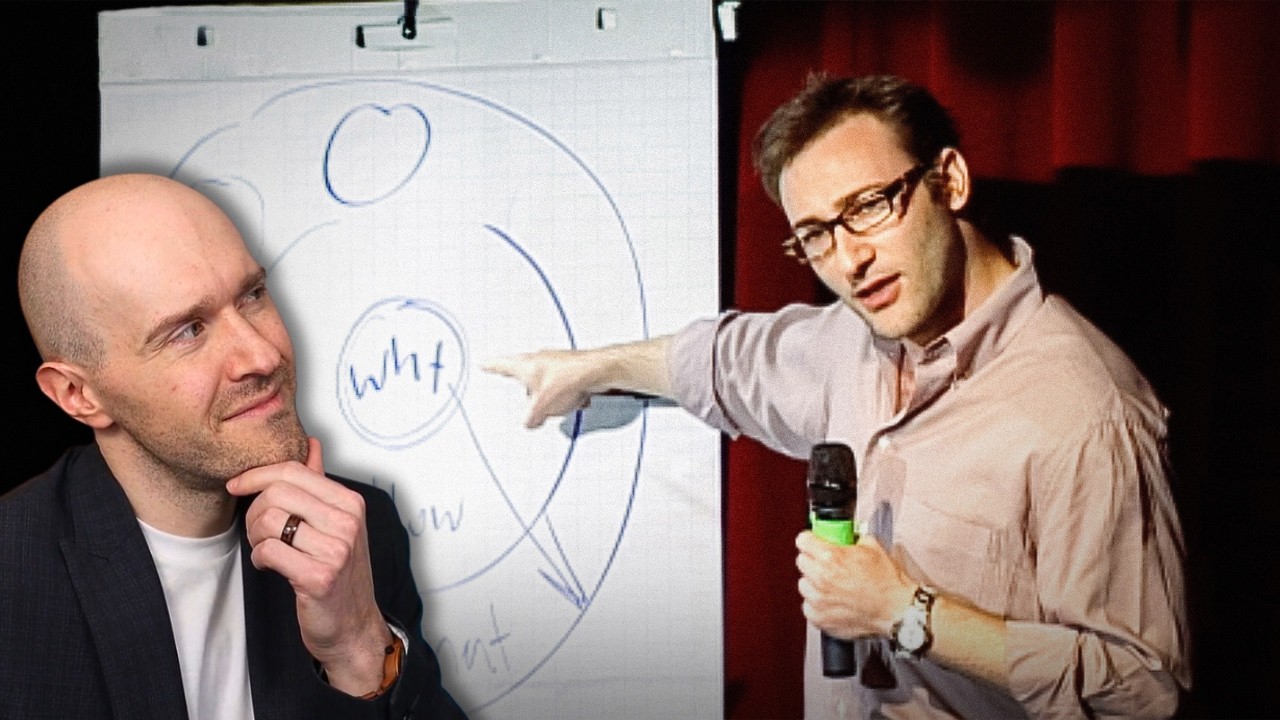
In an era of slick slide decks with cinematic videos and high-resolution photography, Sinek's visual aid is refreshingly simple: a flip chart with a few hand-drawn circles.
And yet, it's one of the most effective visual aids in TED Talk history. As Sinek discusses his core concept — the Golden Circle of Why, How, and What — he draws arrows, points to the circles, and physically walks the audience through his thesis. The simplicity of the visual makes the concept easy to understand and impossible to forget.
I genuinely believe this speech would have had far less impact without that flip chart. Sinek's admittedly messy circles and "substandard artistic abilities" actually work in his favour. They feel authentic and accessible. They strip away any pretence and let the idea itself take centre stage. It's a powerful reminder that your visuals don't need to be fancy — they need to be functional.
The Five-Branch Structure Every Speaker Should Learn
One of my favourite things about this talk is its structure. It's simple, clean, and incredibly effective. Sinek's speech follows a five-branch framework:
- Introduction: The powerful opening question and the three relatable examples that preview what's to come.
- Branch One — Apple: Using the flip chart and the Golden Circle to explain how Apple communicates differently.
- Branch Two — The Wright Brothers: Applying the same visual framework to explain why they succeeded where others failed.
- Branch Three — Martin Luther King Jr.: Illustrating the concept of Why through one of history's greatest leaders.
- Conclusion: Tying all three stories together into a cohesive, memorable takeaway.
This is a structure I recommend to anyone struggling to build a speech. Once you establish your introduction and conclusion, you only need three main points in the middle. That's it.
If you're giving a wedding speech, those three branches might be a story about the person getting married, their greatest qualities, and the partner they've chosen. If it's a work presentation, perhaps it's the data, a relatable story that puts the data into perspective, and future projections. The five-branch structure is versatile, easy to follow, and — as one of the greatest TED Talks of all time demonstrates — remarkably effective.
Handling the Unexpected Like a Professional
Partway through the talk, something goes wrong: someone comes up and hands Sinek a replacement microphone. For many speakers, this kind of interruption would be deeply rattling. When something unexpected happens during a presentation — a technical glitch, a slamming door, a ringing phone — it can completely derail your focus.
But Sinek handles it flawlessly. He simply grabs the new microphone, transitions seamlessly, and never loses his cadence. It's an expert-level skill that speaks to his experience and composure on stage.
When something goes wrong during your own presentations, you essentially have two choices:
- Ignore the distraction and keep going, as Sinek did.
- Acknowledge it briefly — without embarrassing anyone — and try to weave it naturally into your speech.
Either approach is valid. The key is to remain composed and maintain your momentum. That's how professionals handle distractions.
The One Missed Opportunity
It's difficult to criticise one of the greatest TED Talks ever delivered, but there is one small moment that could have elevated it even further. While Sinek is discussing the Wright Brothers and has the audience completely captivated, if you listen carefully, you can actually hear a plane flying outside the venue.
Imagine if Sinek had paused, acknowledged the sound, and said something like: "What are the chances? We're talking about the Wright Brothers, and you can actually hear a plane right now." That kind of spontaneous, situationally aware moment would have been electric. It would have demonstrated an extraordinary level of presence and awareness — the hallmarks of a truly elite speaker.
The speech certainly doesn't need this improvement. But it's a reminder that the best speakers are always scanning their environment for opportunities to create unexpected, unforgettable moments.
Key Takeaways for Your Next Speech
Studying Sinek's TED Talk reveals several timeless principles of great public speaking:
- Open with impact. Skip the formal introduction. Start with a question, a bold statement, or a story.
- Use relatable examples. Choose references your audience will immediately understand.
- Vary your pacing. Speed up to build energy, slow down to let key ideas land.
- Keep visuals simple. A hand-drawn diagram can be more powerful than a polished slide deck.
- Structure your speech in five branches. An introduction, three main points, and a conclusion.
- Pause after humour. Give the audience — and yourself — room to breathe.
- Stay composed when things go wrong. Either ignore the distraction or weave it in gracefully.
Simon Sinek's TED Talk endures not because of its production quality but because of its ideas, its structure, and the skill with which it's delivered. Whether you're preparing a keynote, a wedding toast, or a team presentation, these principles can transform the way you communicate. Study the greats, practise deliberately, and remember: sometimes the simplest approach is the most powerful one.